Code Review Bottlenecks When Agents Outpace Human Reviewers
Automated architectural checks can replace line-by-line review.
Sponsored by Graphide
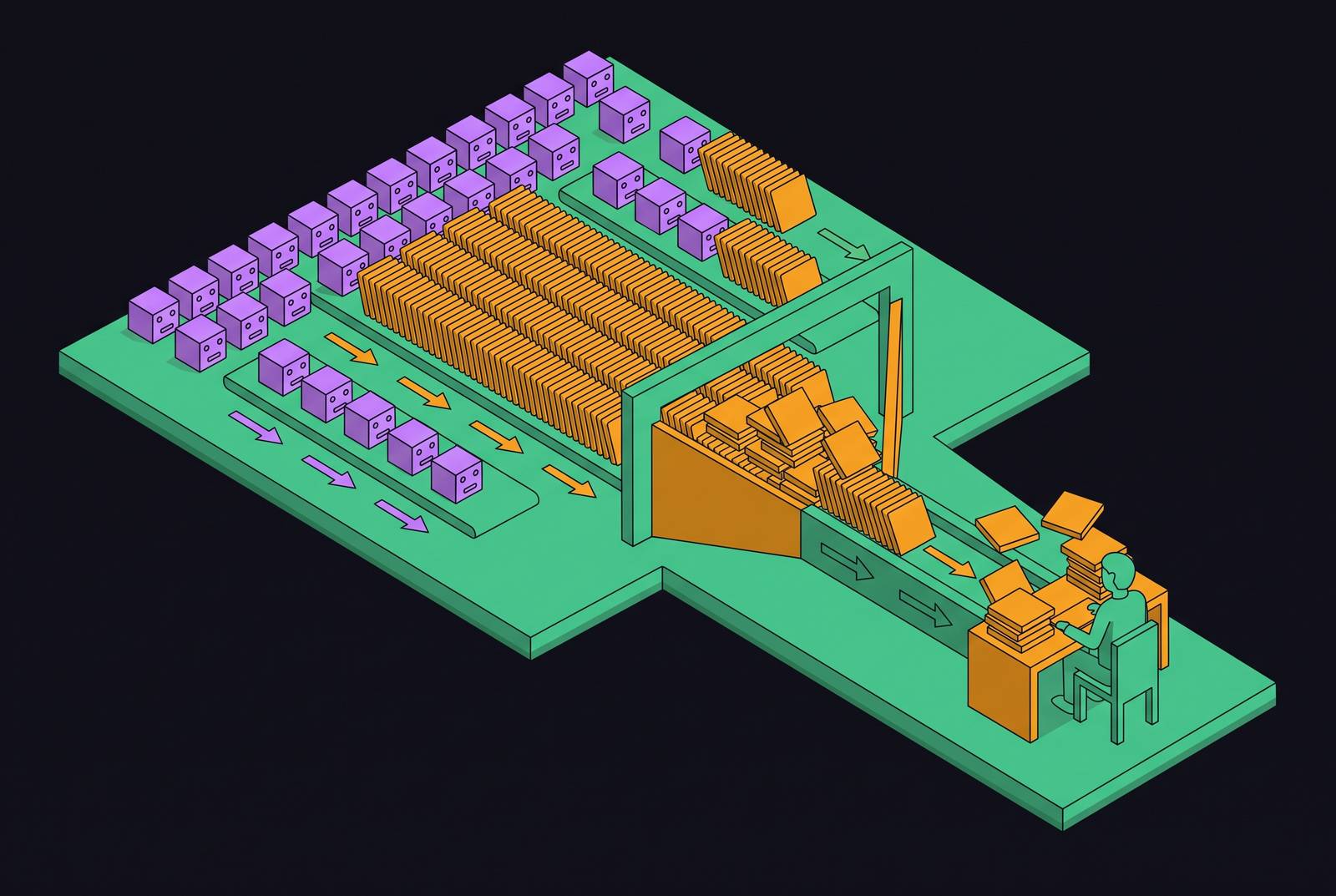
The code review alternative for large AI-generated diffs is machine-enforced architectural constraints, backed by a live map of the codebase and human review of intent. When agents outpace reviewers, verification becomes the bottleneck, and reading every changed line is no longer a workable primary gate. The durable response is to block structural violations automatically and reserve human attention for decisions that require judgment.
Why the bottleneck has shifted from writing code to verifying it
The shift happened “gradually, then suddenly,” to borrow a literary framing. Agents can produce functions, tests, and modules in seconds, but generation does not establish that the output belongs in production. That judgment remains downstream, where someone must establish whether the change solves the problem without damaging the system around it. As authorship accelerates, this verification step becomes the binding constraint on delivery.
The traditional review model assumes that producing a change takes enough time to leave room for another developer to examine it. Agent generation breaks that balance because producing a patch and understanding its consequences now proceed at very different speeds. Anthropic reports internally that “as we've begun to push more code around the organization, human code review has become a new bottleneck”. Adding review capacity leaves the underlying model intact, with every new burst of generation creating another obligation to read and reconstruct intent.
What the volume numbers actually look like inside real codebases
Chowdhury et al., MSR '26, report that OpenAI Codex created hundreds of thousands of pull requests in open-source GitHub repositories in under two months since its release. Stripe's internal Minions agents produce thousands of pull requests that get merged each week and contain zero human-written code. The July 2026 Carnegie Mellon and Stanford study tracked PR volume growing roughly twice as fast as the reviewer pool at one mid-sized AI-forward company, leaving each reviewer with roughly twice the prior load.
Why is an AI pull request that changes forty files harder to review
The difficulty is not just that more pull requests arrive. A reviewer also has fewer sound assumptions to work from inside each one. With a colleague's change, the reviewer can ordinarily start from an expectation that the author understood the problem, considered obvious edge cases, and made deliberate choices. Agent authorship does not support those assumptions. The reviewer must reconstruct the relationship between the request and the implementation rather than simply examine another developer's reasoning.
That reconstruction covers several distinct judgments, including whether the output solves the problem, introduces a subtle security flaw, duplicates existing logic, or follows conventions closely enough to remain maintainable. A patch can look sound on its own and still fail one of these wider tests. Agent code optimizes for immediate task completion. It does not carry the system knowledge of a developer who has worked in the codebase for years. Layer violations, circular dependencies, and boundary crossings can therefore remain non-obvious to a reviewer scanning changed lines.
How review queues collapse in practice: silent approvals and theater
When more pull requests arrive and each is harder to review, an approval can stop showing that someone checked the code with care. The July 2026 Carnegie Mellon and Stanford study followed 802 developers and found that the share of PRs receiving any written human feedback fell substantially. Silent approvals per reviewer roughly doubled. An engineer at a mid-sized startup described the behavior directly to Gergely Orosz, saying, “Everyone is playing the theater of doing reviews”. The gate remains visible, but its presence no longer establishes the depth of verification behind it.
The absence of written feedback does not prove that an individual approval was careless. At queue level, however, fewer comments and more silent approvals under rising load weaken the value of approval as a quality signal. The failure need not begin with a formal decision to abandon review. It can begin when reviewers no longer have enough time to apply the existing policy with its intended care. A required approval is then a workflow condition without a dependable verification standard.
What empirical research shows about AI reviewers filling the gap
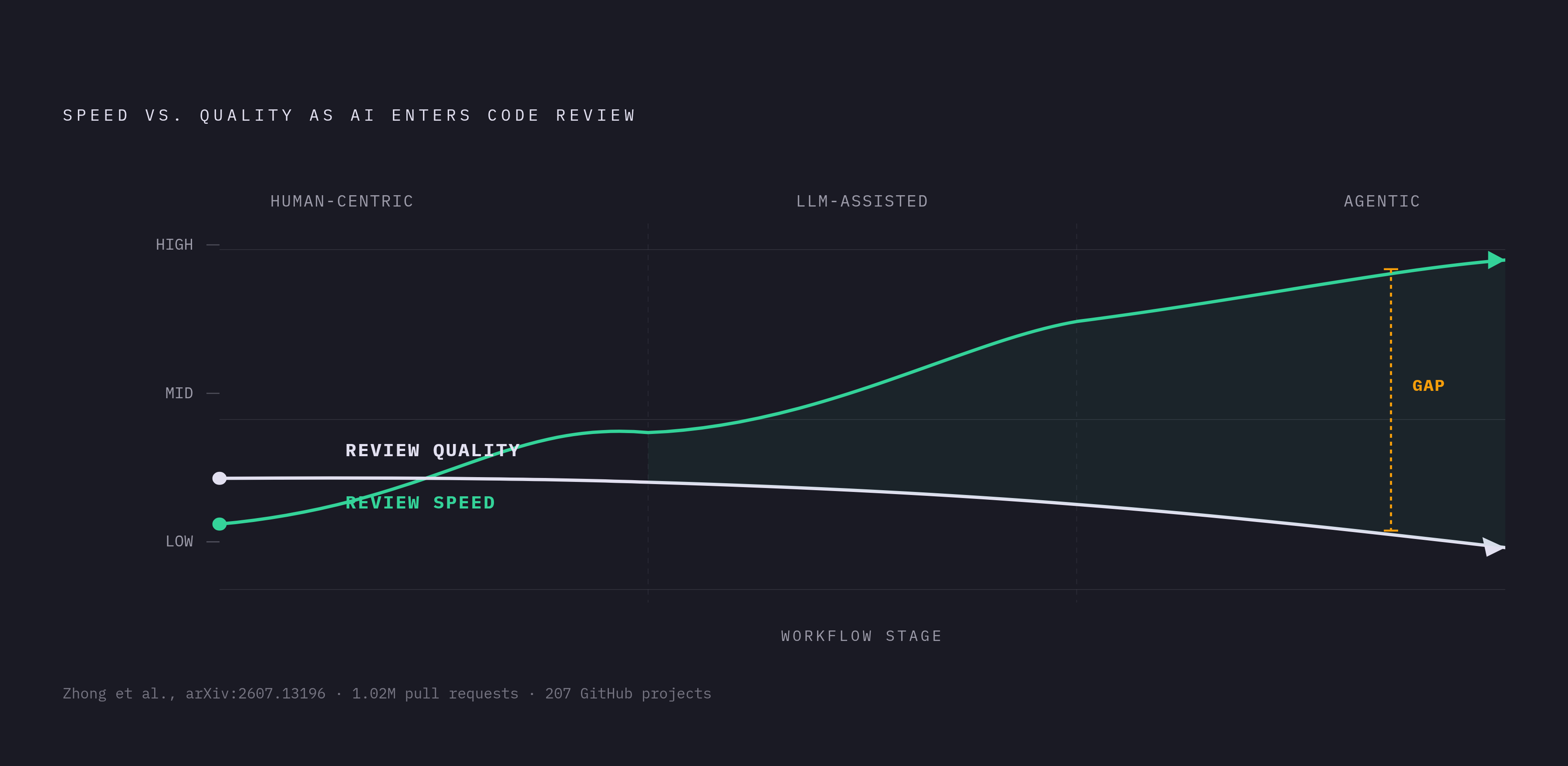
AI code review agents appear to offer a direct answer to the shortage of review capacity, but the research separates faster decisions from better review. Zhong et al., arXiv:2607.13196, studied 1.02 million pull requests across 207 GitHub projects moving through human-centric, LLM-assisted, and agentic review eras. Reviews that involved agents were linked to faster review decisions, but the quality of review did not improve along with the speed. Rapid LLM adoption was also significantly associated with increased code review smell prevalence.
Zhong et al. found that once AI reviewers took part, how humans and AI worked together did the most to explain review efficiency. Automation changes the review process. Its value depends on which responsibilities it receives and how its output reaches a human decision-maker.
Chowdhury et al., MSR '26, found that pull requests reviewed only by code review agents were substantially less likely to be merged and significantly more likely to be abandoned than human-only PRs. Their signal-to-noise analysis placed a majority of closed CRA-only PRs in the lowest signal range. Nearly all examined agents had average signal ratios below the threshold for reliable actionability. Those results do not support broad claims that agents can handle the vast majority of PRs without human involvement. AI reviewers can accelerate parts of review, but the evidence does not establish them as a drop-in replacement for human judgment.
How Stripe's Minions architecture shows what actually makes agent review work
Stripe's Minions architecture illustrates a different response, in which the workflow constrains agent output before the human approval step. Stripe's codebase spans hundreds of millions of lines and runs mostly Ruby with Sorbet typing. Its payments workload makes reliance on a reviewer catching every consequential error untenable. Agents can generate large amounts of useful code inside infrastructure designed to make required checks unavoidable.
Stripe calls its workflows “Blueprints”. These workflows are defined in code, with some nodes running an agentic coding loop and others running deterministic code. The deterministic nodes complete specified subtasks regardless of what the model produces. Test validation is a gate enforced by the harness rather than an instruction the model can choose whether to follow. This distinction turns part of verification from a requested behavior into a property of the workflow.
Conditional rules for each subdirectory also load different instructions based on which part of the codebase is being changed. Architectural guidance is therefore scoped to the task and location instead of being loaded wholesale into every session. All agent-generated code still undergoes human review before merge. Engineers review the code instead of writing it, and structural constraints have already caught types of errors that come from not knowing the system's design. The human step remains, but it no longer carries the entire burden unaided.
That arrangement depends on years of compounding investment in the devbox system, test suite, tool library, and agent customization. Stripe's implementation takes more than a weekend to build, and its stack will not suit every team. Its value as a proof of concept lies in the placement of responsibility. Required checks belong in the harness, while contextual instructions belong where the agent needs them.
Why architectural constraints encoded as machine-enforceable rules are the durable answer
For this to work over time, architectural intent must be encoded as executable constraints that agents cannot bypass and CI cannot skip. Layer boundaries, dependency direction, and module isolation should hold even when a reviewer forgets a rule that applies. Documentation describes the desired system, but an enforced rule can block a change that contradicts it. A check that exits non-zero and blocks the merge has more force than a post-hoc architecture review. It removes a known class of decisions from an overloaded queue.
ContextCov research, arXiv:2603.00822, formalizes constraints into four domains, namely Process, Source, Architectural Deterministic, and Architectural Semantic. Each of these domains has a Domain-Specific Expert Generator. Its Source Expert uses AST queries with Tree-sitter to traverse parse trees. Its Architectural Expert uses graph algorithms with NetworkX to find cycles, layer violations, or boundary crossings. The important design principle is that different kinds of constraints require representations suited to what they test.
A CI/CD policy engine can then block critical violations and use confidence thresholds to decide whether an agent's actions need human approval. Risk-based triage can classify changes as low-risk or elevated-risk and route only elevated-risk changes to human reviewers. This preserves attention for decisions that automated constraints cannot settle. Hard limits on changed lines and a rule against bundling unrelated refactors into a single PR also help keep reviewers' work in check. Neither measure replaces verification, but both reduce the cognitive load that makes silent approval tempting.
Architecture checks alone do not show that the code is fully correct. Machines enforce explicit structural rules, while humans assess intent and the elevated-risk decisions left unresolved. That division depends on rules that describe the real codebase. A graph-based view shows the relationships that need to be checked and enforced. It is therefore the practical foundation for maintaining the constraints.
Why a live architectural map is what makes constraint-based review practical to operate
A team cannot protect boundaries it cannot see. Files and diffs show the details of the implementation, but on their own they do not show enough to reason through changes across many modules. Before dependency direction or module isolation can become an executable rule, the team needs a shared view of those relationships. The map must also remain connected to the changing codebase. A diagram drawn once and then left out of date cannot keep up with verification at agent speed.
Current verification workflow
Large agent-written changes need both a CI verdict and review findings whose evidence a reviewer can inspect. Graphide CI runs existing GitHub Actions jobs on Graphide runners, using warm caches, and splitting long test steps only where a check shows every result stays the same, to reduce waiting while preserving the pass/fail verdict. A failing test fails the job. Graphide review is a separate product that presents changed behavior and findings with evidence; it does not block merging on its own. Consult the current documentation for supported workloads and limitations.
Product information updated November 5, 2026 to reflect Graphide’s current CI and review products.
Sources
- From Human-Centric to Agentic Code Review: The Impact of Different Generations of Generative AI Technology on Review Quality
- From Industry Claims to Empirical Reality: An Empirical Study of Code Review Agents in Pull Requests
- AI Writes Faster Than Humans Can Review: A Longitudinal Study of an Enterprise 2x Mandate