The Graph Interface That Replaces the Prompt Box for Repository-Scale Agent Direction
Graph-based scoping cuts navigation overhead as agent sessions grow longer and more complex.
Sponsored by Graphide
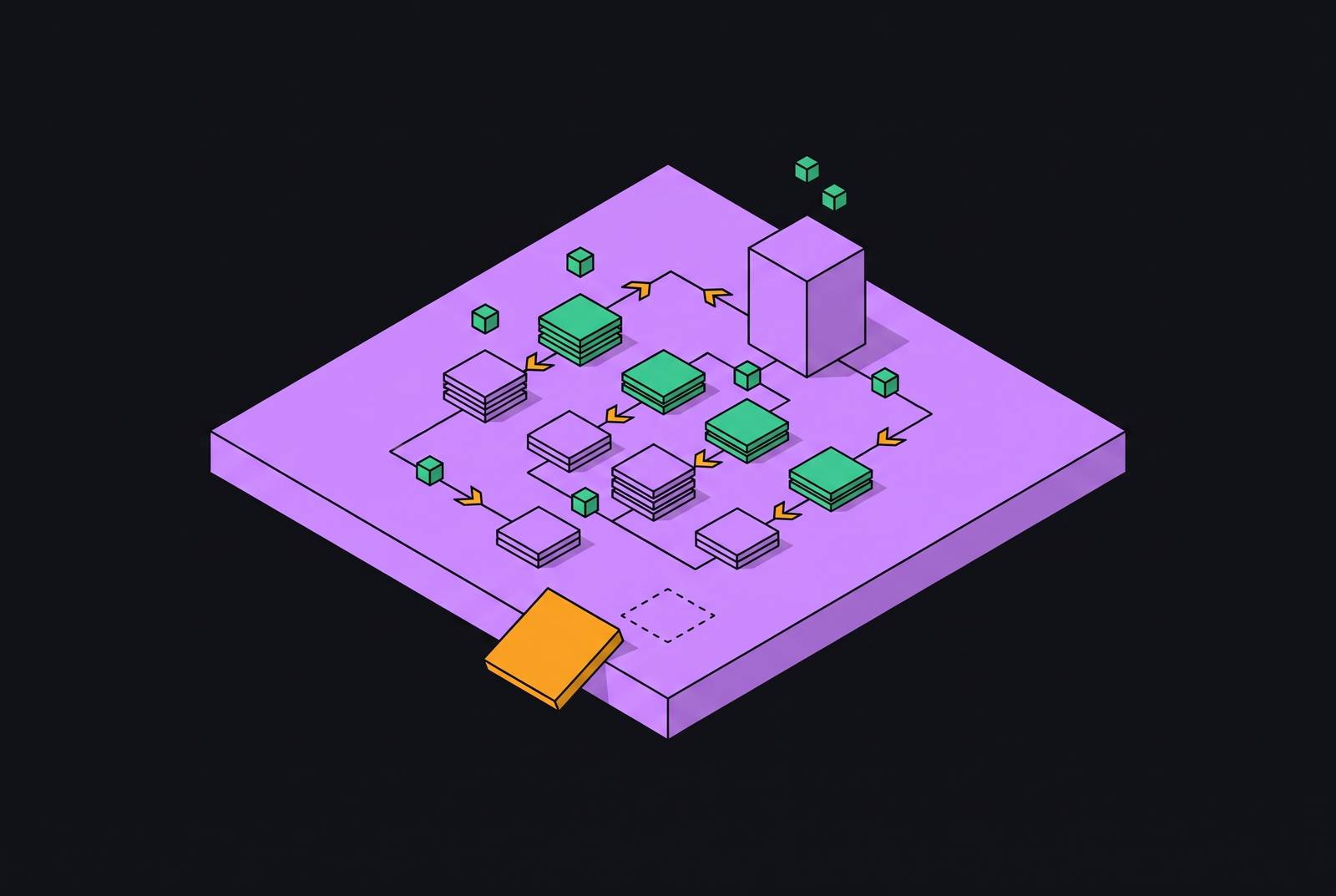
An interactive codebase graph for AI agent steering makes repository structure the main way to direct work. Developers choose modules, call paths, and dependency clusters, then give agents context for that scope and clear constraints. The prompt becomes an annotation on that selection, while the graph provides a shared model for navigation and verification.
Why the prompt box is the wrong unit of direction at repository scale
The agent greps the repository, reads the wrong file, reads another, and greps again with a different pattern. Before it edits anything, navigation has consumed a substantial fraction of its context window. The agent has no map, so it explores. Free-text instructions describe the desired change but provide no persistent, shared model of where that change belongs.
One developer’s test of a 50K-line repository exposed the cost of this approach. A common keyword kept leading the agent to unrelated files, and each wrong file remained in context for the rest of the session. A stronger model might find its way back from those detours, but they still have a cost. This is an interface failure.
Longer autonomous runs make that failure more expensive. Between Q1 2025 and Q1 2026, coding agent sessions went from lasting minutes to much longer, multi-step runs with dozens of tool calls. With more reads, writes, commands, and iterations, navigation overhead has more chances to build up. Yet the prompt box still makes each session reconstruct the repository’s structure before doing the requested work.
What grep and embeddings cannot answer that a graph can
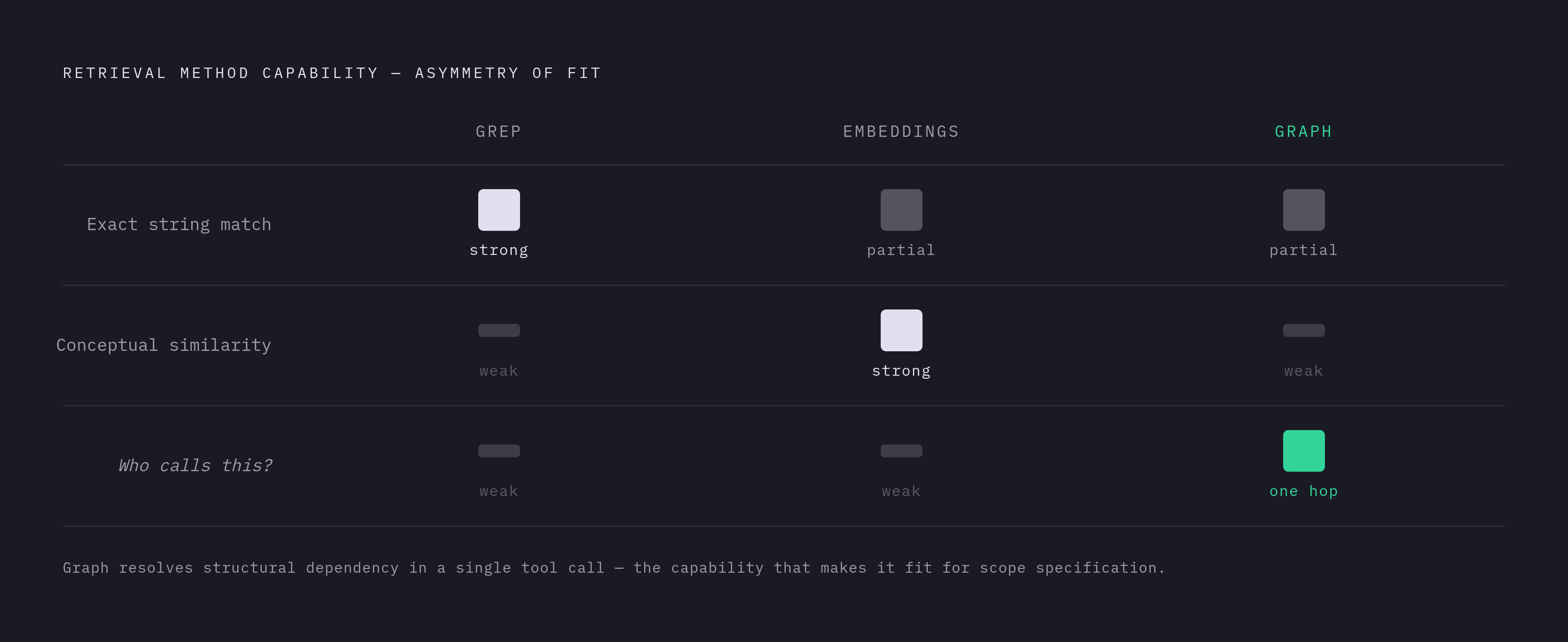
Grep answers a question about strings. It finds exact matches quickly, but repeated names and indirection separate a textual match from the symbol an agent needs. A query such as “who calls this?” may require several searches and file reads to resolve intervening layers.
Embedding-based retrieval addresses a different weakness of exact search. It can find conceptually related material when the developer does not know the right identifier, making it useful for vague questions. But similarity does not establish a precise structural boundary. Line-based chunking can also split functions mid-body, separating code from the context needed to interpret it. Embeddings remain useful without becoming an authoritative account of dependencies.
An abstract syntax tree provides the basis for that structural account. Parsing extracts functions, classes, modules, and imports, which become entities connected by relationships in a queryable graph. The agent navigates those relationships rather than reconstructing them through broad file reads. A represented call relationship can answer “who calls this?” in one hop. Queries about what a change could affect can likewise return connected symbols in a single tool call.
The distinction is therefore not that one retrieval method wins everywhere. A graph is weak at vague conceptual queries, while grep remains appropriate for exact strings and embeddings for conceptual similarity. Structural questions need structural answers. That difference makes the graph suitable not just for retrieving context, but for specifying the scope within which an agent should operate.
How do developers direct AI agents through a pre-indexed codebase graph?
The developer selects a module, a call path, or a dependency cluster on a live map of the repository. That selection defines a bounded scope before the agent begins. The agent then receives a context packet derived from the relevant nodes. The task description explains the intended change without also having to reconstruct its location and boundaries in prose.
This changes what the interface makes explicit. A prompt can name a module, but a graph selection also exposes its dependencies and call relationships. When permissible relationships are encoded in that model, the agent’s navigation space has defined limits. Scope is no longer merely an interpretation of prose. The prompt remains useful for expressing intent, but the graph becomes the object the developer points at.
The underlying infrastructure has been moving in this direction. From mid-2025 to early 2026, local tools increasingly built repository maps using syntax parsers, ctags-like symbol extraction, SQLite full-text indexes, and embedded graph stores. Enterprise tools began using semantic indexing and central graph services that many agents could query. These approaches share a practical pattern. They precompute structure and expose narrow facts through tools instead of repeatedly spending context on broad file reads.
For that interface to be trustworthy, it must distinguish evidence from interpretation. Edge labels such as EXTRACTED, INFERRED, and AMBIGUOUS show how much confidence to place in a relationship. Provenance also shows whether a fact comes straight from code, a relationship was inferred, or a claim comes from documentation. A shared model is useful only when its users can understand what supports it.
What the graph costs to build and at what scale it pays off
Indexing introduces overhead before it removes exploratory work. Under a modest file count, that overhead can outweigh the savings, and an agent’s search-and-read approach remains survivable. Above a mid-range scale, graph-based context starts producing material gains. There is no supported universal file-count cutoff here. At the scale of the Swift compiler, Chromium subtrees, and large monorepos, however, structured indexing becomes necessary for repository-wide navigation.
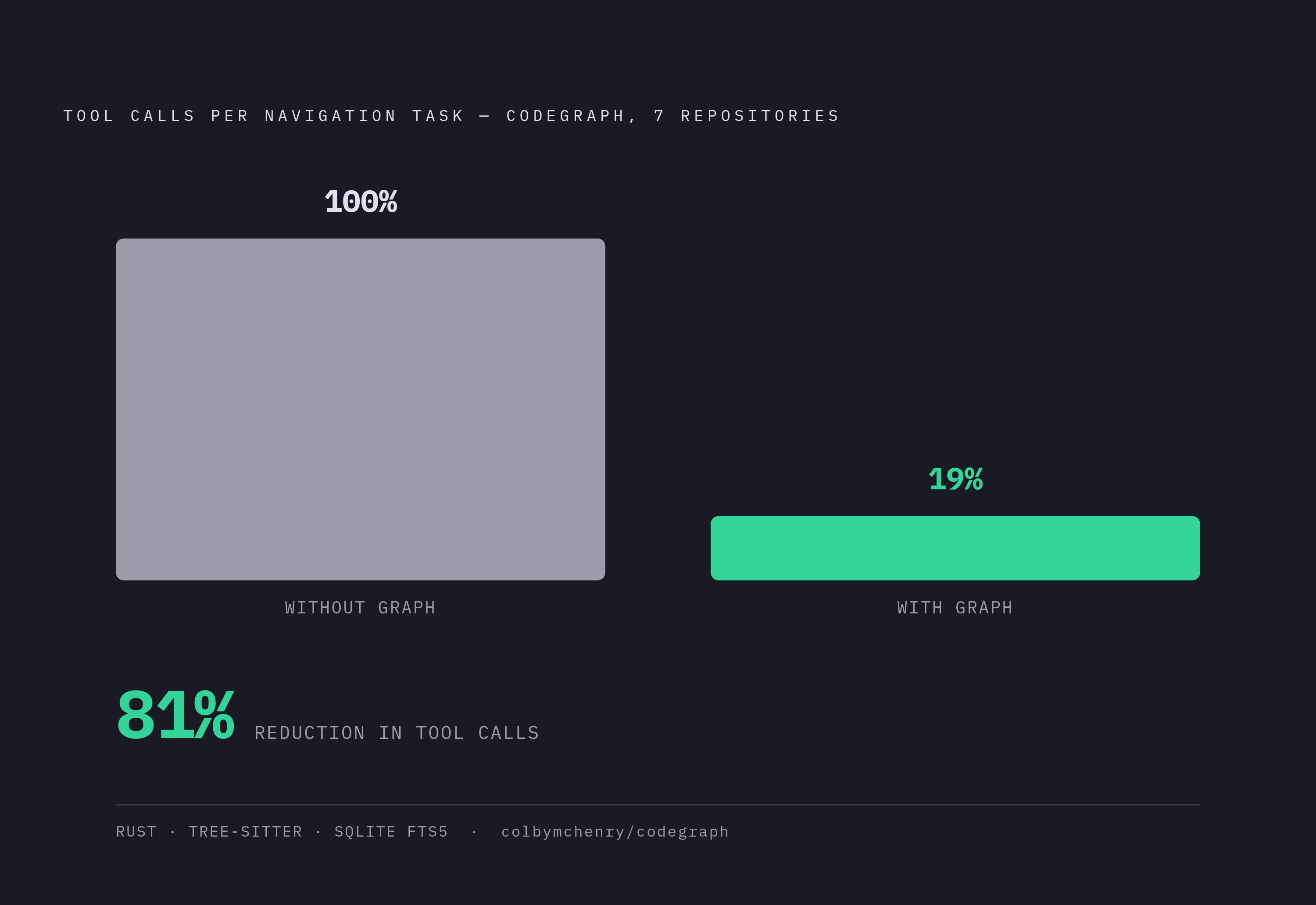
The colbymchenry/codegraph project illustrates the local indexing approach. Its native Rust parsing kernel uses tree-sitter to extract symbols and relationships into a local SQLite database with FTS5 full-text search. CodeGraph reported an 81% reduction in tool calls with the graph enabled compared with agents without it, evaluated across seven real-world repositories.
Cognee provides a related approach with different interface and schema choices. It parses codebases into entities and relationships, can use a user-supplied ontology, and otherwise falls back to LLM-extracted entities without a predefined schema. Its API lets agents query the graph in real time. It is self-hostable and includes a visualization interface for inspecting node relationships and ontology structure, with graph backends including Neo4j, Memgraph, and FalkorDB. Real-time querying, however, is not by itself a guarantee that the underlying map reflects the latest code.
The objection to graph infrastructure is legitimate. A visualization can connect everything to everything while changing nothing about daily work, and an aging graph can give an agent false confidence. Maintenance can consume tokens as well as engineering effort. The design constraint is therefore concrete. The graph must rebuild with the code and help agents make fewer mistakes by choosing the right files, avoiding work already done, and explaining what could go wrong.
Review and verification do not get easier when agents write faster — they get harder
Better navigation improves the context an agent receives, but it does not establish that the resulting change is correct. As agents write code across more files, review becomes a bigger bottleneck. The diff still groups changes by line. That is a mismatch of scale and interface. A reviewer can inspect individual edits without seeing which modules now depend on which or which boundaries the combined change crosses.
The March 2026 empirical study of code review conversations across 300 open-source GitHub projects found that human reviewers exchanged 11.8% more rounds when reviewing AI-generated code than human-written code. The same study found that AI-agent suggestions had a lower adoption rate than human suggestions. These findings challenge the idea that writing code faster makes it cheaper to review. They establish why direction and verification must be treated as separate problems.
A strong majority of developers do not fully trust the functional accuracy of AI-generated code, yet roughly half do not verify it before committing. Distrust alone does not provide a workable review method. When the available interface is a large multi-file diff, thorough inspection competes with the volume of generated changes. Architecture drift can slip through that gap even when people take care with their reviews.
A graph provides a different surface for examining the result. Dependency changes, crossed boundaries, and violated constraints are structural questions, just as caller relationships were structural questions during navigation. The same model can support both stages of work. Its role at review time is not to replace every close reading, but to expose relationships that a line-by-line diff leaves the reviewer to reconstruct.
Encoding architectural constraints in the graph so CI can enforce them automatically
A graph becomes an enforcement substrate when it records permissible relationships as well as existing ones. A rule that one module must never depend on another layer can then be evaluated against a proposed change. CI can check the constraint before merge rather than leaving it as a reviewer’s mental checklist. The rule becomes executable. This is the practical distinction between an architectural diagram and an architectural control.
The agent needs those rules in its working context, too. An instruction such as “You will never generate code where X depends on Y” defines an explicit boundary for generation. But an instruction alone does not enforce compliance. The corresponding check makes a violation detectable before the code ships. Because an agent lacks the team’s implicit history and understanding of prior compromises, those boundaries cannot remain tacit.
Hard and soft constraints serve different purposes. Hard constraints are non-negotiable rules, including prohibited dependencies and a requirement never to deploy when security scans detect critical CVEs. Their checks exit non-zero and block the merge. Soft constraints warn when code nears complexity thresholds, has more coupling, or stretches boundaries, but they let the merge go ahead.
In 2026, GitHub expanded automatic security validation to third-party coding agents, showing how changes can be checked before merge. Agent-generated changes can be analyzed with CodeQL, checked against the GitHub Advisory Database for dependency risks, and scanned for secrets before the pull request is finalized. These security checks do not themselves enforce a repository’s architectural graph.
Open Policy Agent uses Rego to write rules and decisions as code. That policy-as-code approach can govern the architectural envelope within which an agent works, just as it governs infrastructure deployment. The repository must therefore make its implicit constraints explicit and executable. CI’s guarantee is limited to ensuring that encoded checks pass. The quality of enforcement depends on what the model actually represents.
What the developer's role becomes when the graph, not the prompt box, is the primary interface
The developer’s work shifts toward choosing the scope and deciding which relationships a change may affect. That requires more design judgment. Longer agent runs and broader edits make deliberate control of the working area more important than repeated refinement of instructions. The “agent shepherd” role described through 2025–2026 follows from this change in scale.
Line-by-line reading still has a place within that workflow. It becomes less sustainable as the primary way to understand everything an agent changes across a repository. Structural navigation shows which relationships and boundaries matter, while close reading looks at the code inside them. Neither view is sufficient for every question.
That division of labor requires a durable shared model. The graph must live in the repository, version with the code, and support enforcement in CI. Otherwise, the developer and agent can be steering against a design that no longer exists. Currency is part of the interface contract.
Large context windows still have a place alongside this approach. Agents may still need substantial files, logs, traces, or design documents, and practitioners disagree on where graph intelligence ends and raw context should begin. The useful distinction is between structure and content. The graph defines the scope and relationships, while raw context supplies the detail within that scope. Repository-scale direction becomes more durable when the developer controls that structure instead of repeatedly asking prose to stand in for it.