Live Codebase Graph as a Steering Interface for AI Agents
AI agents need a shared structural map to coordinate changes and preserve architectural constraints.
Sponsored by Graphide
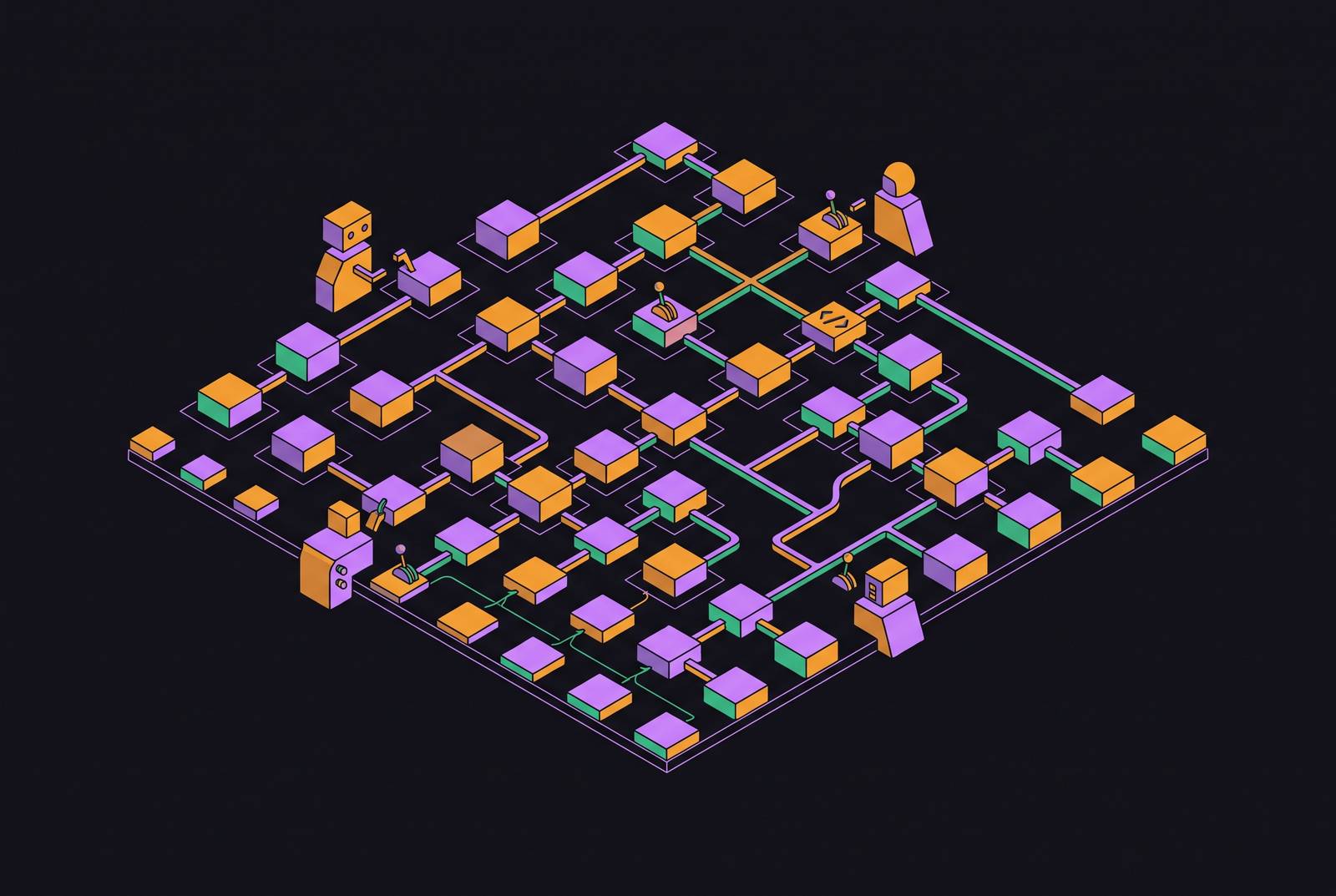
A live codebase graph is an interactive steering interface for AI agents. It gives agents a shared map before they edit, lets developers inspect structural changes while work proceeds, and makes architectural constraints enforceable in CI.
Why AI agents make line-by-line review structurally inadequate
A single agent prompt can touch dozens of files and produce thousands of lines of diff. The developer’s instinct is still to open that diff and read down, checking each change against the surrounding code. That approach made sense when humans wrote every line. It becomes inadequate when one task spans the full call graph of a service, because the reviewer must reconstruct relationships that the diff presents only as scattered edits.
The mismatch is structural. A flat diff shows additions and deletions, but it does not expose callers, callees, layer boundaries, or the full blast radius of a change. Those relationships decide whether an edit that makes sense on its own fits the system. Reading more lines does not automatically reveal that an agent has crossed a bounded context boundary or introduced a dependency that the architecture excludes.
The Stack Overflow May 2026 pulse survey found that 63% of developers rarely or never let agents run entirely on autopilot. However, as agent output increases, meaningful oversight depends less on reading every generated line and more on seeing what those lines do to the system’s structure. An interface must expose that structure while there is still time to steer the work.
What a codebase graph actually represents and how it is built
A codebase graph is a machine-readable representation extracted directly from source. Static analysis builds its structural layer with parsing, symbol extraction, and edge tracing. An AST, a call graph, and an import dependency graph expose different parts of that structure without requiring a model to infer them from prose.
Graft’s documentation describes a structural layer that uses tree-sitter to pull out functions, imports, and the edges that connect them with zero API cost. The index is built once and remains queryable, with updates needed as source changes. Its nodes can represent modules, files, functions, classes, and architectural layers. Richer schemas also include business features and domain owners, so the model covers more than the source hierarchy.
CodeWeaver’s graph schema distinguishes structural encapsulation through BELONGS_TO, invocation through CALLS, dependencies through USES, and connections to product capabilities through IMPLEMENTS. These edges have different meanings and answer different questions. In a property graph, Cypher queries can follow several hops to find relationships that would be expensive to reconstruct through file reading. These queries return exact results over the encoded relations.
CodeCompass describes the “Navigation Paradox” as a shift from retrieval capacity to navigational salience when context windows expand. More available tokens do not remove the need to select relevant structure. A graph lets the agent query those relationships, saving it from having to find them again and again in a larger pile of source.
How do you give an AI coding agent a live map before it edits?
Without a graph, an agent commonly begins by inspecting the file tree, searching for names, opening nearby files, inferring ownership, and reading tests. Each step can be reasonable on its own. The expense comes from repeating the same reconstruction across sessions and agents. With a persistent graph, the agent can first query entry points, inspect callers and callees, identify likely affected files, and then read the relevant source.
Graft illustrates the difference with a query about where export permissions are checked. It returns the export function, permission helper, route handler, and document-loading function together as a connected working set. A keyword search would not assemble that cluster, leaving the agent to trace the relationships before it could begin the requested change.
Axon provides both agent access and visual navigation over its index. Running axon analyze . resolves call chains, type relationships, community clusters, execution flows, dead code, and coupled file pairs from git history. Running axon ui opens an interactive dashboard where a node exposes its code, callers, callees, and impact radius. The Model Context Protocol, or MCP, supplies the integration layer through which agents can query the index as tools in the IDE.
The operating rule is to use the graph to choose where to look, then use the file, test, and runtime to decide what is true. This preserves the distinction between orientation and verification. An agent arrives at the edit with a focused structural map, without treating the map as a substitute for the implementation it is about to change.
Why multi-agent parallelism breaks without a shared structural substrate
When agents work concurrently, repeated discovery becomes a coordination problem. Two agents can inspect the same file, form separate models of its role, and write incompatible changes without either knowing what the other intends. Each may understand the current source well enough for its own task. The failure lies in the absence of shared knowledge about work in progress.
By the time both sets of changes reach the branch, the agents have already acted on assumptions that may no longer fit together. A common structural map supplies a place to connect intended changes to the modules, functions, and relationships they affect. To coordinate active work, that map must expose more than a snapshot of committed code.
DevGraph handles this by having agents query the graph before they start, share their planned changes as they code, and see other agents’ changes in real time. Conflict warnings can then arrive before incompatible code is written. The graph holds memory that agents share, in place of separate context copied into each agent’s session.
Gas Town shows why that memory must last beyond a single session. Its Mayor coordinator, Polecat workers with ephemeral sessions but persistent identity, and merge-queue manager depend on a structural substrate that survives agent restarts. Coordination cannot rest entirely inside temporary conversations. The requirement is continuity of shared structural state across the roles that plan, implement, and merge changes.
How a live graph lets developers intercept architectural drift before it merges
An agent can change a call relationship, cross a layer boundary, or add a dependency on a module it should not touch. In a diff, those decisions appear as lines. In the graph, they appear as changes to relationships, where their fit with the system’s architecture can be assessed.
A new edge between a controller and a database layer is directly inspectable as a structural delta. So is a call chain that crosses a bounded context boundary, or a module that gains callers it was not designed to serve. The reviewer can ask whether the edge belongs, rather than infer its significance from dispersed edits. That changes the basis of intervention from local plausibility to intended design.
Graft’s graft check command reports whether its graph is stale relative to current source and identifies changed files. This is a freshness signal. It identifies where re-analysis is needed before the graph can support review of the new structure. Understand Anything’s diff impact analysis adds a view of what the current changes affect across the dependency graph.
Developers can inspect the emerging shape before accepting it into the codebase. That depends on the graph tracking the work as it changes. A diagram drawn once is a historical document.
Why the graph must be enforced in CI rather than trusted to human review
Even a developer reviewing structural deltas can miss a subtle violation under time pressure. Human attention remains a probabilistic control, while agent throughput expands the review surface. Explaining architecture in a prompt does not close that gap. An agent can comply with some constraints and drift on others, with different results across runs.
The consequence is to encode architectural constraints as executable tests in CI. Layered separation can stop controllers from accessing the database directly, while other rules can enforce dependency inversion or bounded context boundaries. These are structural invariants. Functional tests alone can leave them undetected because working behavior does not establish that dependencies follow the intended design.
The strongest objection is that another gate slows delivery. However, a constraint check that runs in milliseconds against a pre-indexed graph costs less time than a re-review cycle after a structural regression has merged. This comparison does not remove the work of keeping the index current. The time saved by fast structural checks is why they belong at the acceptance boundary, where checks would otherwise depend entirely on how much attention a reviewer has left.
What the graph-as-steering-interface model requires to hold up in practice
Freshness is the first condition for reliable steering. A stale index answers questions about a codebase that no longer exists, allowing an agent to make confident edits against obsolete relationships. Re-indexing when a push occurs offers a middle path for paying the cost of updates. Nevertheless, the authority of any graph answer depends on whether the indexed state matches the source under consideration.
Static analysis also has a defined reach. It captures explicit calls and import edges, but routes generated by convention, behavior hidden behind decorators, and metaprogramming may not appear in the graph. When the stakes are high, developers must challenge graph results with direct search and check the relevant source, tests, and runtime behavior.
The graph records structure. It can show that a controller calls the database directly, but not explain why the team established that boundary. The reasons may be in review threads and meeting notes. Human checkpoints remain necessary where a decision depends on organizational intent rather than a relation that static analysis can extract.
Privacy imposes a separate condition on tool selection. Cloud-hosted graph services are constrained by whether the codebase can leave the premises, while local-first tools execute on the developer’s machine. These distinctions define where the model can be authoritative. The graph works best with up-to-date relationships that it has explicitly captured and constraints that have been encoded, while people still have to judge incomplete runtime structure and reasons that have gone unwritten.
How the developer role changes when the graph is the primary interface
The traditional workflow keeps the developer at the line level, reading, writing, and reviewing code. Agent-assisted work separates those activities because the developer specifies while the agent produces. Checking that work needs a shared view of the structure between them. The graph gives developers a way to operate on architecture rather than hope that it survives a sequence of individually acceptable patches.
Versioning the graph with the code, making it queryable in the IDE, and enforcing its constraints in CI gives architectural intent a place in the development process. The developer can intervene when the map and the source diverge, or when a proposed edge requires a design decision.
Without that interface, architecture drift can accumulate through decisions that look reasonable separately but become incoherent together. With it, oversight shifts from reading every change to directing and verifying the relationships those changes create. The developer remains accountable for the design. The live graph is the surface through which that intent becomes enforceable.
Putting architectural checks in CI
Choose an architecture-test or dependency-rule tool that supports your language and the constraints you can explicitly encode. Commit its rules with the code, run the documented command in CI, and make the resulting check required where those rules should prevent a merge. Test the gate with an intentionally forbidden dependency before relying on it. Such checks enforce the rules you specify; they do not establish that every aspect of the architecture or runtime behavior is correct.
Updated November 5, 2026: obsolete CLI examples removed. Use the selected tool’s current installation and command documentation.