Mutation Testing for AI-Generated Code
Mutation testing shows whether tests catch wrong AI-written code.
Sponsored by Graphide
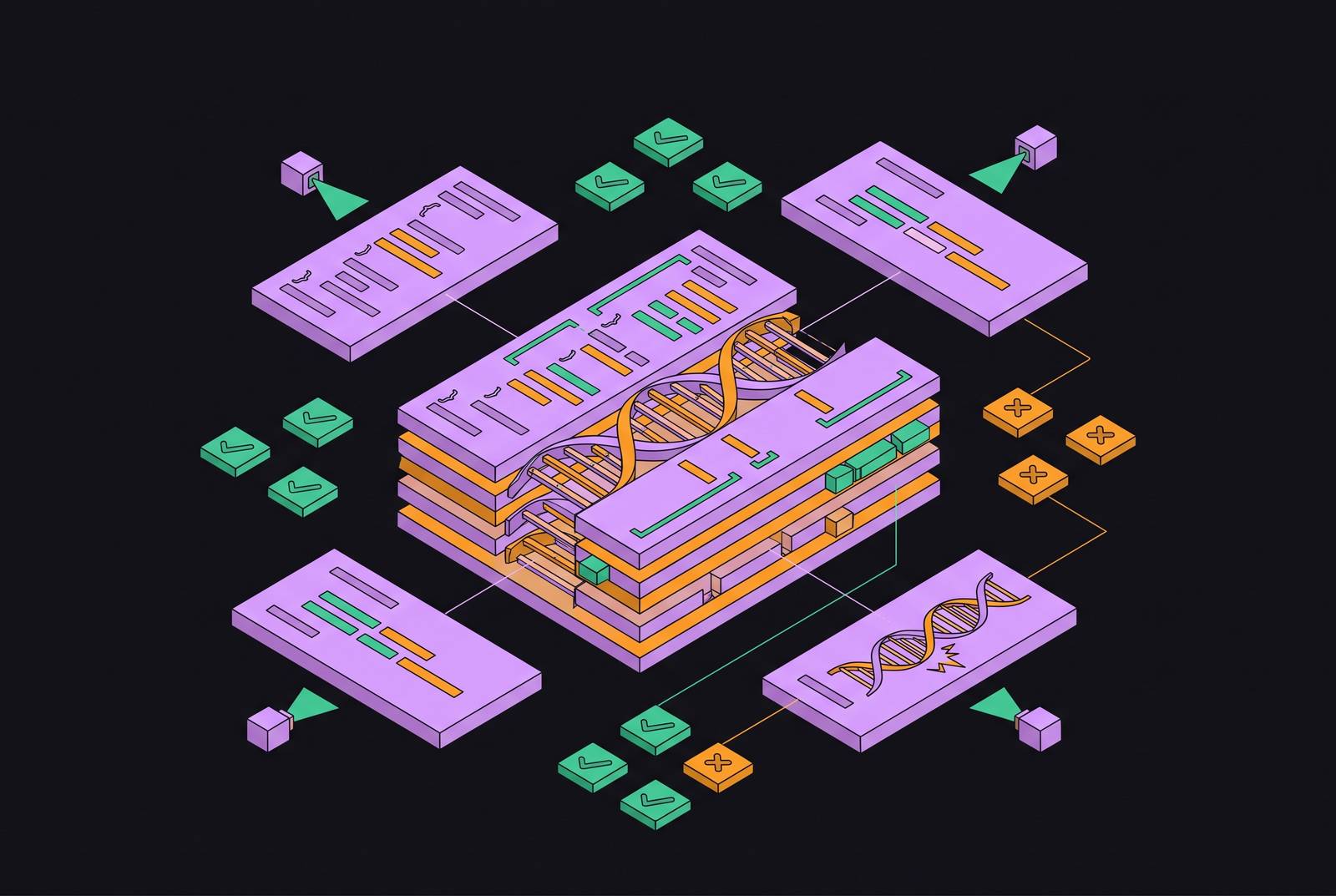
For large AI-generated diffs, mutation testing offers a way to check whether tests catch deliberately wrong behavior, so teams need not rely on line-by-line review alone. Mutation Testing for AI-Generated Code explains how to make that check a CI gate on changed modules. Architectural checks add to the gate by testing structural constraints, but a passing suite or a mutation score cannot prove that every requirement is correct.
Why passing tests no longer mean correct behavior when agents write the code
An agent writes an implementation, then writes tests that reproduce its misunderstanding of the requirement. The code and tests agree, so the suite passes even though the behavior is wrong. The code can be syntactically correct and stylistically consistent, with no comments flagging uncertainty. That fluent commitment to an incorrect implementation is the pattern called “confident incorrectness”.
The review burden is measurable, although it is not universal. Qodo’s 2026 State of AI Code Quality Report found that 36% of developers say reviewing AI-generated code takes more mental effort even when it takes about the same time. That minority still represents a real “trust tax”. Coverage cannot pay it down because execution alone does not show that an assertion protects a requirement.
What mutation testing actually does and why it closes the gap coverage leaves open
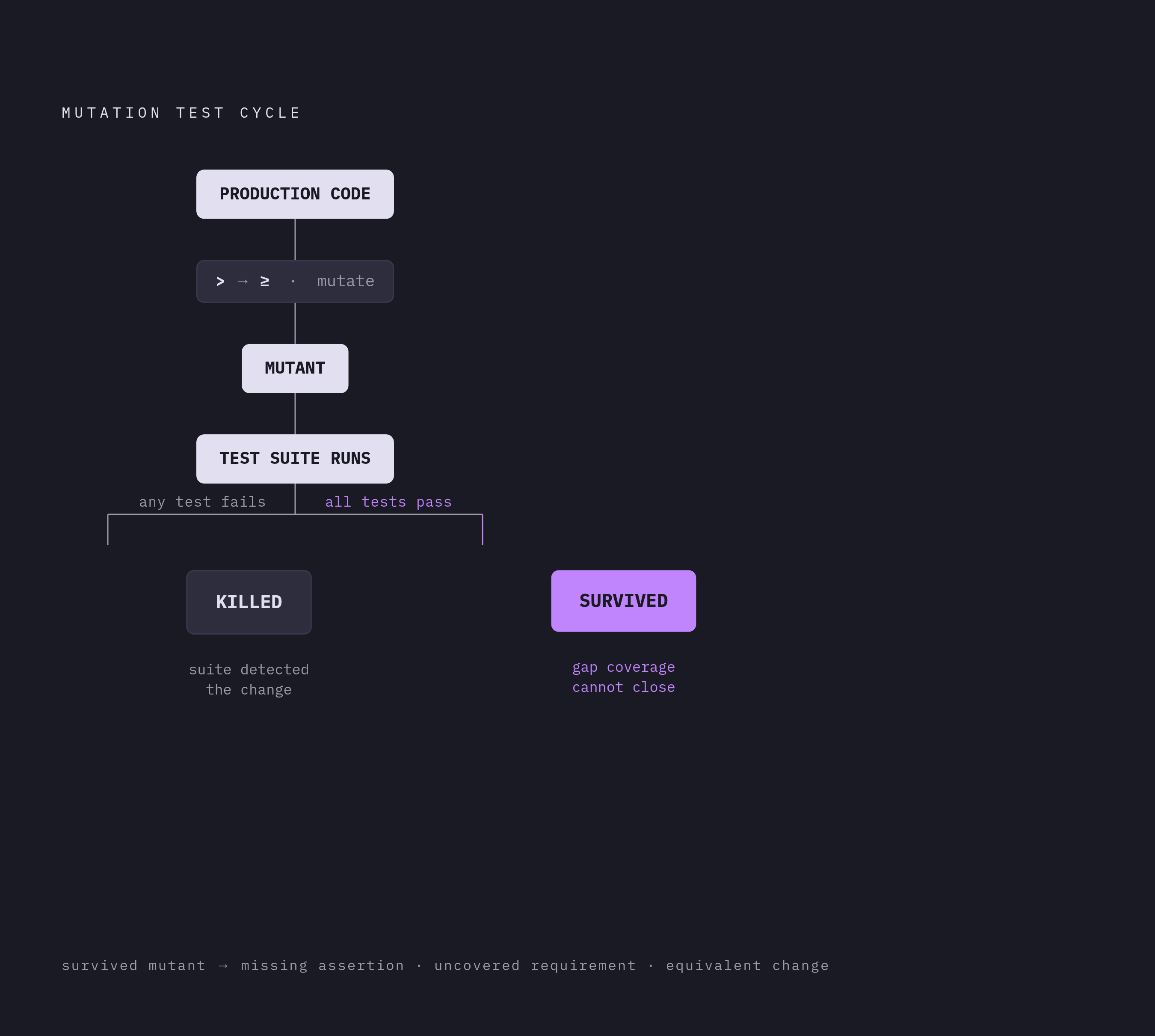
Mutation testing evaluates a test suite by changing the production code it tests. A mutation tool creates one small, controlled change, called a mutant, and runs the suite against that version. The change might replace > with >=, substitute false for true, or remove a method call. Other operators return null instead of an object, negate a condition, or replace an arithmetic operation.
A mutant is killed if any test fails against it. It survives if every test stays green, showing that the suite did not detect the change. A no-coverage result identifies code that the tests did not reach, rather than code they reached without an effective assertion. The mutation score is killed mutants divided by total non-equivalent mutants. Running code without asserting anything meaningful about it can raise line coverage, but it cannot raise that score.
A survivor may expose a missing assertion, an uncovered requirement, or a deliberate design decision. It may also be equivalent to the original code and unable to affect observable behavior, in which case it should not count against the score. Coverage asks whether a line was executed, while mutation testing asks whether the suite would notice if the behavior on that line were wrong.
Why the structural properties of agent-generated code make it uniquely vulnerable to surviving mutants
An agent can generate production classes, fixtures, and dozens of test cases in a single session. That can be too much code for a human to review, let alone check whether every generated test has a useful assertion. Local tests can then validate each part without constraining its effect on the wider system. The weakness is structural.
Using the same model for implementation and tests compounds that weakness because more generated tests need not mean more independent scrutiny. If the implementation and tests encode the same incorrect business rule, adding examples of that rule only reinforces their agreement. A surviving mutant reveals a change in behavior that the suite misses despite that agreement. It does not independently recover the intended requirement. Instead, it directs attention to the point where the tests need comparison with that requirement.
How SWE-bench's test-suite weakness validates the mutation approach at benchmark scale
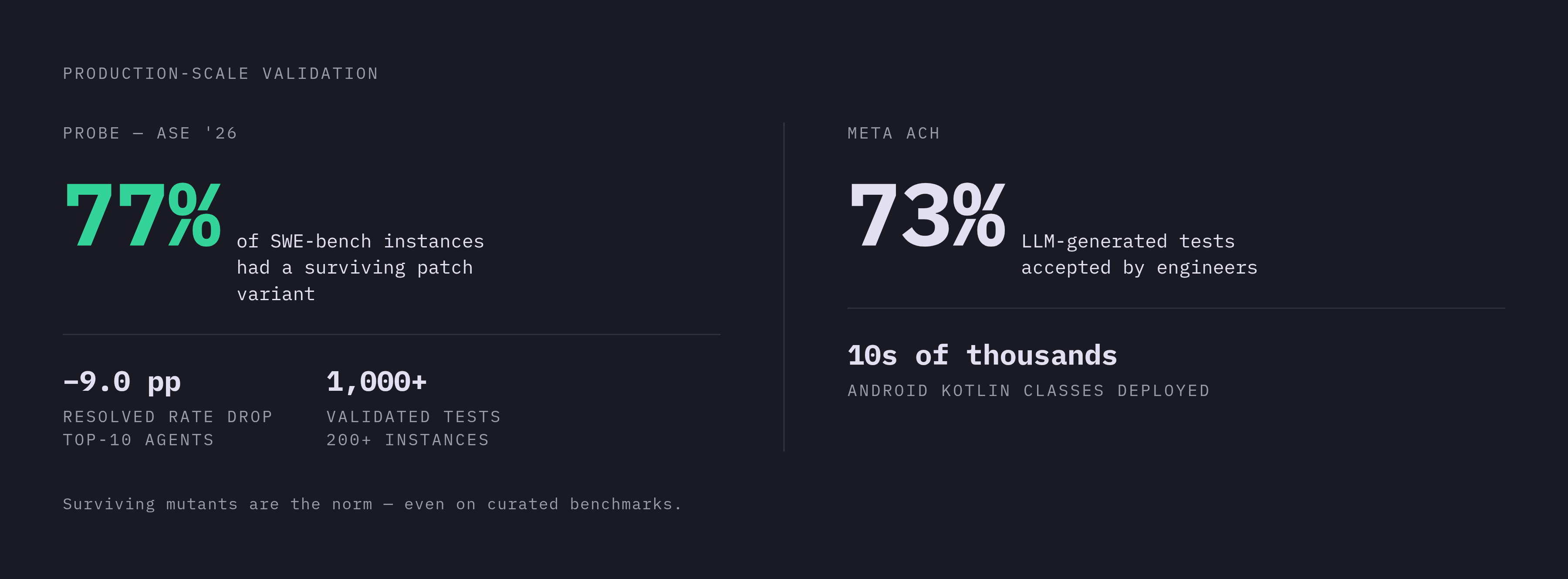
PROBE (ASE '26) makes the gap measurable on a software-repair benchmark. The study found that 77% of instances admit at least one surviving variant of a reference patch. Those variants pass the original tests despite semantic modifications, revealing behavior that the suites leave under-constrained. The result shows that the test suites are weak, but it does not show that every accepted agent patch is wrong. It shows why passing the benchmark’s regression tests can overstate correctness.
PROBE uses those surviving variants to guide the regression tests it generates. It retains a generated test only if it passes on the reference patch, fails on at least one surviving variant, and remains robust under behavior-preserving transformations. PROBE generated over a thousand validated tests across more than two hundred instances, raising patch-region line and branch coverage meaningfully.
When PROBE tested top-10 repair agents again, their resolved rates fell by several percentage points up to 9.0%. A semantically incorrect patch that passes weak tests is the benchmark counterpart of a surviving mutant. For production teams, the results warrant caution about test-suite weakness. Less curated suites and larger, less scrutinized agent changes provide no reason to assume the same weakness disappears.
What a production deployment of LLM-guided mutation testing looks like at scale
Meta’s Automated Compliance Hardener, or ACH, provides a production example of LLM-guided mutation testing. Meta used ACH on tens of thousands of Android Kotlin classes across several software platforms. Messenger and WhatsApp participated directly through test-a-thons in which engineers accepted 73% of generated test cases, judging many to be privacy-relevant. That acceptance rate demonstrates practical usefulness, although it is not a measure of complete behavioral correctness. ACH was also presented at keynote sessions at FSE 2025 and EuroSTAR 2025.
Its compliance focus shapes the mutations it generates. ACH can omit authorization checks, mishandle data fields, or violate privacy or compliance requirements. ACH also deploys an LLM-based equivalent mutant detection agent to identify changes that cannot affect observable behavior before they consume test execution time. Simple pre-processing makes the detector’s precision and recall much better.
This deployment shows both the technique’s reach and its cost. Meta has tooling resources that few others have, and its compliance work gives it a reason to invest in generating and filtering targeted mutations. ACH is therefore evidence that production deployment is possible. The computational overhead of semantic mutation testing in fast-feedback CI remains an unsolved problem for most organizations. A practical quality gate has to narrow the work.
How LLM-generated mutants differ from traditional syntax operators and why that matters for agent output
Traditional mutation operators are deterministic and independent of business context. They explore a fixed grammar of changes, which makes them useful for testing sensitivity to conditions, calls, return values, and arithmetic. Agent defects, however, are often semantic. A wrong field mapping, mishandled retry, reordered event sequence, or technically valid response that violates a product contract may require a more targeted probe. The important distinction is whether the mutation resembles a plausible defect in the behavior under test.
SMART (FSE '26) addresses that distinction with retrieval-augmented generation over a vectorized dataset of real-world bugs, focused code chunking, and supervised fine-tuning. The SMART study reports a real bug detection rate of 92.61%, with gains in mutation validity, effectiveness, and efficiency. Its approach can also enable smaller models to match or surpass larger ones. The finding supports calibrating mutants to real bugs rather than treating model size or mutant count as the main objective.
AdverTest (ISSTA '26) takes another approach that can work alongside this one by pairing a test generation agent with a mutant generation agent. The mutant agent finds blind spots, and the test agent refines tests to kill the resulting mutants. On Defects4J, AdverTest improves fault detection substantially over the best existing LLM-based methods and over EvoSuite. Equivalent mutant filtering, as used in ACH, addresses another source of wasted work. For agent output, targeted semantic mutants around missing guards, wrong mappings, and incorrect state transitions are more valuable than exhaustive syntactic permutations.
How to review large AI-generated pull requests with a mutation-testing quality gate
Start with the modules and files the agent changed. This keeps execution time more tractable and makes the score relevant to the change awaiting review. Route low-risk changes, including documentation, configuration, and trivial logic, through a fast path. Changes to critical paths, security boundaries, or public APIs need deeper mutation coverage. The review strategy becomes risk-based rather than proportional to the number of lines in the diff.
Set a mutation score threshold for critical modules and enforce it through a CI gate that exits non-zero when the threshold is not met. A score in a report is advisory, while a failing gate blocks the merge. The threshold is a pragmatic heuristic. Its purpose is to turn an agreed testing constraint into an enforceable and auditable rule.
Use agent-assisted triage to turn surviving mutants into directed investigations. An agent can inspect the affected production method, find the tests that executed it, explain the observable difference, and separate uncovered code from weak assertions. It can also identify likely equivalent mutants and propose a focused test. The AdverTest pattern can then run before merge, as mutant generation finds blind spots, test generation fills them, and the mutation score is checked again.
Keep exhaustive whole-codebase mutation out of the initial scope. Complex semantic operators on uncritical utility code and manual triage of every survivor are also avoidable early cost drivers. These limits concentrate the central enforcement mechanism on the behavior whose failure matters most, with mutation testing complementing other forms of review.
Why mutation score becomes a governance instrument as agents produce more of the codebase
As agent output grows beyond what a human review queue can absorb, quality evaluation has to become part of the delivery system. The engineer’s role shifts toward architecture design, agent coordination, evaluation, and strategic problem-solving. CI/CD, test automation, and architectural oversight provide the foundations for that work. Without them, faster generation can accumulate behavioral debt faster than retrospective review can address it. Mutation score gives governance a measure of how well tests catch the modeled faults.
The goal is to make important constraints executable at the point of merge. Reliable agent-driven delivery depends on enforcement infrastructure that runs at agent speed, and mutation score is one of the few instruments sharp enough to be part of it.
Current verification workflow
Mutation testing checks whether a test suite can detect deliberately introduced faults. It complements CI execution; neither a passing run nor a coverage percentage alone establishes mutation adequacy. Graphide CI runs existing GitHub Actions jobs on Graphide runners, using warm caches, and splitting long test steps only where a check shows every result stays the same, to reduce waiting while preserving the pass/fail verdict. A failing test fails the job. Graphide review is a separate product that presents changed behavior and findings with evidence; it does not block merging on its own. Consult the current documentation for supported workloads and limitations.
Product information updated November 5, 2026 to reflect Graphide’s current CI and review products.